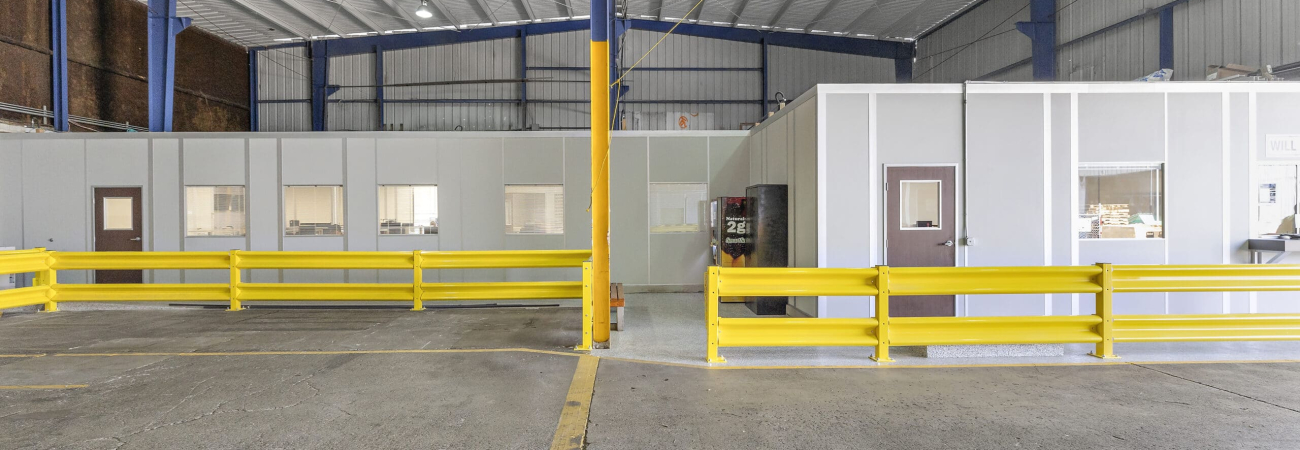
If you’ve ever tried to take a phone call on a warehouse floor, you already know how difficult it can be. Whether from moving forklifts, conveyors, various types of machinery, or whatever else is running, a normal conversation is at times nearly impossible.
And this isn’t a mere nuisance either. OSHA sets the noise exposure limit at 90 decibels over an eight-hour shift, which means plenty of manufacturing and warehouse environments get very close to that (or blow right past it).
If you’re considering creating office space in such environments, but are hesitant because of the noise, don’t worry. A good modular office can cut that noise down to a workable level.
In this article, we’ll go over how modular office panels generally handle noise, what double-wall construction is, and what to think about if you’re ordering one for a loud facility.
How Modular Office Panels Handle Noise
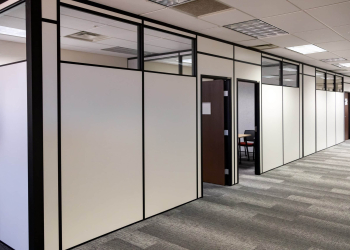
Of course, in a modular office, the panels themselves are what stand between you and the noise. A standard modular office panel has a vinyl-clad or painted drywall surface with insulation in between, and this alone can knock down a fair amount of sound.
The measurement the industry uses is called STC, or Sound Transmission Class. It’s a single number that tells you how much sound a wall blocks. The higher the number, the quieter it is on the other side.
- At STC 35, loud speech is understandable but normal speech is muffled.
- At STC 45, loud speech is audible but not understandable.
- At STC 50 and above, loud speech is faint and hard to make out.
Standard modular office panels generally fall in the STC 35 to 42 range. You won’t be working in total silence, but you’ll be able to hold a conversation and focus without shouting over the floor.
Double-Wall Construction for Louder Spaces
But this isn’t all modular can do. If you’re dealing with a particularly loud place then standard panels might not cut it.
If that’s the case, then double-wall construction can improve soundproofing even further.
It works like this: Instead of one wall panel, you build two separate wall layers with a gap of air between them. Since sound travels through solid materials pretty easily, that pocket of air disrupts the vibration and absorbs a lot of the energy before it reaches the other side.
Double-wall assemblies can push STC ratings into the 50s and even 60s. At that point, a loud factory floor on the other side sounds like a distant background hum inside the office.
It’s Not Just the Walls
Walls get the most attention, but sound finds the weakest point and comes through there. A few other things matter:
- Doors. A solid-core door blocks way more sound than a hollow-core one. Worth asking your manufacturer about.
- Windows. Glass typically lets more sound through than a solid panel. Thicker glass or double-pane helps, but it’s mostly a trade-off between visibility and quiet.
- Ceiling. If the office doesn’t go all the way up to the roof deck, sound comes over the top. Ceiling panels with a high NRC (Noise Reduction Coefficient) rating help with that.
- Gaps and seals. Even small gaps around doors, panel joints, or where conduit enters the wall may let in more sound than you’d expect.
The Bottom Line
If you’re considering building modular offices at your location, and you suspect noise is going to be an issue, bring it up early. The best time to deal with soundproofing is during the design phase, not after the office is already up.
Allied Modular offers soundproof wall options on their in-plant modular offices. If you want to talk through what level of noise reduction makes sense for your facility, reach out to us today or request a free quote.