If you’re buying a modular office or similar building, you might want to know what it’s made of.
Why?
Because the materials affect everything from how long it lasts to whether it meets your building codes.
So, in this guide, we’ll go over the main types of modular building construction materials, from framing and wall panels to cores and fire-rated options.
Framing Materials
Let’s begin with framing materials.
You can think of the frame as the skeleton of the modular building, in that it holds the panels together and determines a lot about the structure’s strength and weight.
The two most common framing materials are aluminum and steel.
Aluminum
Aluminum is probably the more common choice for modular building frames. It’s lightweight, strong, and naturally resistant to things like rust and corrosion. Also, because it’s lighter than steel, aluminum-framed buildings are easier to move and reconfigure, which is one of the main advantages of going modular in the first place.
Steel
Steel framing is heavier, but it’s also more rigid and has greater structural integrity. If you need a building that’s going to take a beating, or be exposed to high-traffic areas, industrial environments, etc., then steel framing is the better option. It’s also non-combustible, which can be a factor in fire code compliance.
Wall Panel Surfaces
The surface of the wall, on the other hand, is what you actually see and touch. It’s what determines how the office looks, how easy it is to clean, and how well it holds up over time.
There are quite a few options here, each with its own strengths.
Vinyl-Clad Gypsum
First, there’s vinyl-clad gypsum, which is one of the most popular choices for modular offices. It’s smooth, tough, and pretty easy to clean and maintain.
If you’re building a standard office, break room, or conference room, vinyl-clad gypsum is a solid all-around option.
FRP (Fiberglass-Reinforced Plastic)
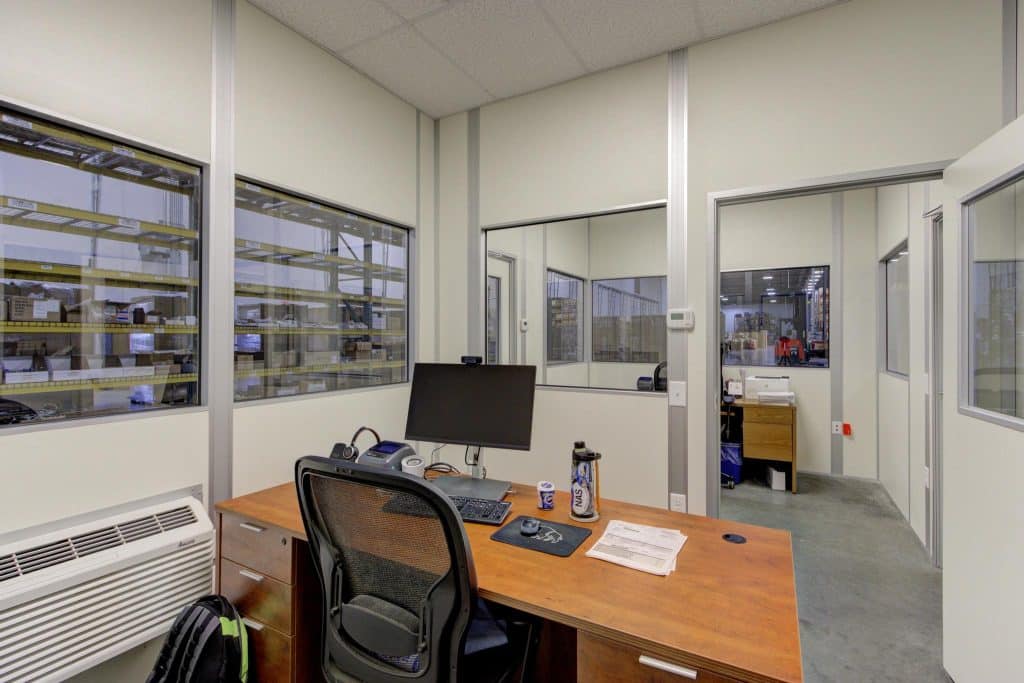
FRP panels are common in spaces where moisture may be a concern. They’re resistant to water, corrosion, and mold, which makes them a great match for places like food processing environments, or really anywhere that humidity is high. They’re also low-maintenance and easy to clean.
Steel-Coated Panels
If strength and fire safety are priorities, then steel-coated panels are worth considering as well. They’re non-combustible, tough, and long-lasting. You’ll often see these in industrial spaces where the walls need to hold up against heavy use.
Hardboard Vinyl
Furthermore, there’s hardboard vinyl, which combines the strength of hardboard with the flexibility of a vinyl coating. It’s a durable option that works well in offices and holds up well in the face of everyday wear and tear.
Glass

Glass panels are popular in office spaces where you may want natural light to flow between rooms. They also create an open, modern feel and are commonly used for conference rooms, front offices, and similar spaces.
Glass partitions can be single-pane, dual-pane, or even sliding, depending on what you need.
High-Pressure Laminate
Finally, if you’re looking for something that resists scratches, wear, and impact, high-pressure laminate is a great choice. It’s common in busy areas where the walls may more easily get worn down, and it also comes in a wide range of colors and finishes.
Core Materials
Then there’s the core materials, which you can think of as sandwiched between the two surfaces of a wall panel. You don’t see it, but it’s doing a lot of the work, especially when it comes to things like insulation, fire resistance, or structural strength.
Polystyrene
Polystyrene is perhaps the most commonly used core material in modular construction. It’s lightweight and has decent insulation properties, which helps with energy efficiency. For standard office environments, polystyrene is usually the default choice.
Polyisocyanurate
If you need better insulation and fire resistance than polystyrene, you can think of polyisocyanurate as an upgrade. It’s commonly used in environments where both temperature control and fire safety are important, as in cleanrooms and labs.
Honeycomb
Honeycomb cores are also interesting because they’re very strong but also very lightweight. This makes panels with honeycomb cores easier to move and reconfigure, which is a real advantage if you plan on rearranging your layout in the future. They’re a popular choice in general for demountable wall systems.
Fire-Rated Materials
Depending on your building codes and what you’re using the space for, you may need fire-rated wall panels as well. This is especially common when you’re separating an office area from a hazardous zone, or when local code requires a one-hour fire-rated wall.
At Allied Modular, we offer our FireLine wall system for exactly this purpose. FireLine walls are rated to withstand sustained temperatures of 1,500 to 1,600°F for 60 minutes, and they meet the requirements of ASTM E84 Class A and ASTM E119.
They’re fully modular, too, so they can be reconfigured or relocated just like any other modular wall system.
Electrical Integration
One thing that sets modular construction apart from things like freestanding partitions or curtain systems is that the walls can have electrical and data built right into them.
Modular wall panels can include UL classified raceways, which are essentially channels inside the wall, that allow you to run wiring for outlets, lighting, phone, and data without any exposed conduit. In other words, everything stays inside the wall, which gives you a clean look and makes future rewiring much simpler.
This is a big deal in office environments where you need power and internet at every workstation. With modular panels, you plan the electrical layout during the design phase, and it’s all integrated from the start.
How to Choose the Right Materials
So how do you know which materials are right for you? Well, it depends on your environment and what your space needs to do. Here are a few general rules of thumb:
For a standard office in a warehouse or factory, vinyl-clad gypsum with a polystyrene core is usually the most practical and cost-effective choice.
For areas with moisture or humidity, go with FRP panels, as they’re built for it.
If fire separation is required, you’ll want fire-rated panels like the FireLine system, likely with a polyisocyanurate core.
If the office is going to get bumped, scraped, or accommodate a lot of people, then steel panels or high-pressure laminate may hold up better than softer finishes.
Furthermore, if you know you’re going to move or reconfigure the space later, go with honeycomb-core panels, as they’re lighter and easier to work with when it’s time to rearrange.
Of course, you don’t have to figure all of this out on your own. A good modular provider will help you choose the right combination of materials based on your specific application.
The Bottom Line
The materials that go into a modular building matter a lot. They determine how the space looks, how long it lasts, and whether it meets the requirements of your particular environment. The good news is that there’s a wide range of options to choose from, no matter what your needs are.