There are many businesses who want to go with modular offices over traditional buildings, but who have trouble determining what the exact costs should be. Without a clear-cut breakdown, it’s easy to under- or over-estimate, which can lead to confusion once confronted with the real costs.
You’ll often hear that modular office buildings cost anywhere from $50 to $300 per square foot, with some bold enough to claim that they may cost $20 per sq. ft. or less.
While the lower end may be overly optimistic, the range itself still holds, though the actual price will depend on a set of basic factors.
In this article, we’ll cover exactly what variables affect the cost of a modular office building. Instead of giving you hard numbers, we’ll do the best we can by laying out the decisions that tend to raise or lower total prices.
Factors That Affect Modular Office Costs
For any modular office, there are many factors that can decide the overall price. Though we recommend getting a quote directly from a manufacturer (as they can give you an accurate number), there are other ways to calculate relative costs. In this section, we’ll help you identify some of the main drivers of prices.
1. Size
The most obvious factor that will affect costs will be the size of the building. All else being equal, a small modular office building will cost much more than a two-story building. That being said, if the project is large enough, the cost per square foot can decline in proportion to the size.
2. Office Layout & Custom Features
Similarly, the more complex your office layout, the more resources it will take to design and build. Take a simple, single-room office, for example. In general, it will cost much less than the same-sized space with multiple rooms, as the latter will require more walls, and likely custom features for each of the rooms.
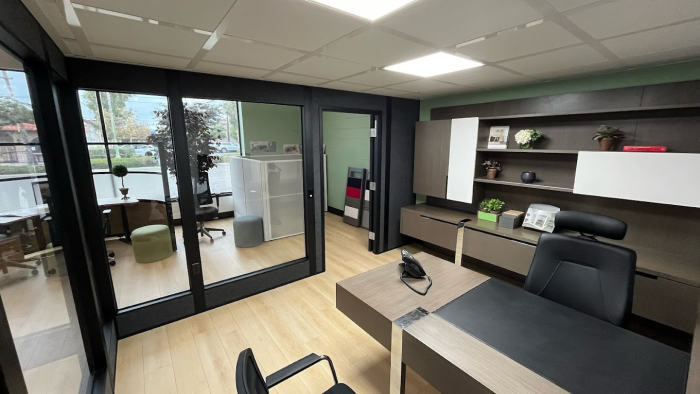
Some of said features could include glass walls, soundproofing, extra doors and raceways, and much more. One thing to keep in mind is that most modular offices are custom-built to whatever your needs may be, so the more you require, the more the final cost will be. This is part of the reason why it’s so difficult to state prices directly.
3. Materials & Finishes
As you might expect, the materials you choose for your modular office building will also affect the final cost. Modular buildings often cost less than traditional buildings, but using materials like steel and aluminum will inflate prices if chosen over more common materials like fiberglass-reinforced plastic or vinyl-covered gypsum.
And of course, selecting soundproofed, fire-rated, or other special panels will add to the total price as well. (For more details, check out some of our interior options.)
4. HVAC Systems
Furthermore, the number of HVAC units will also affect prices. For a basic modular office, a single/standard HVAC unit may do. However, as the size or complexity of the building increases, so will the HVAC needs. Larger offices may require several units to keep the space cool or warm.
5. Location, Transportation, and Installation
Most people don’t consider that the location of your modular office building may also affect the cost. As you may well imagine, the more remote your area (typically), the higher your labor and transportation costs will be. Prices may also depend on where the manufacturer is based, so this should enter into your considerations as well.
Installations are typically billed as a percentage of the cost of materials. This will depend on the manufacturer, but generally hovers around 30 to 50%.
6. Maintenance and Long-Term Costs
Finally, the cost that is least considered is maintenance. Generally speaking, there will be fewer issues with keeping modular offices functional over time. However, you’ll still need to take care of the HVAC system, and replace individual wall panels if they get damaged (luckily, this is simple and no demolition is required).
Energy bills will also depend on how you use the space, as well as how insulated the building is. Fortunately, modular offices are often built with energy-efficient materials.
In addition, these spaces are extremely flexible, which means that if you ever need to change the layout, downsize, or expand your office later on, it’s a simple matter that can take a team a few days. As a result, modular offices have an excellent return on investment.
Modular vs. Traditional Office Construction
Now that we’ve covered some of the biggest factors that influence the cost of modular buildings, it’s worth comparing them with traditional ones. Here are a few cost-adjacent factors to consider when choosing between modular and traditional construction.
Installation Speed
Modular offices can be delivered much faster than conventional buildings, all other things being equal. While this is not directly related to cost, time is money, and the opportunity cost of having a functional office faster should be given some weight. A traditional office may take many months (or even years) to finish, and depending on what you’re using it for, a slower construction process can hurt your bottom line.
Clarity on Pricing
Another benefit of modular over traditional construction is upfront pricing. When beginning a typical construction project, there’s a lot of uncertainty around costs, as you’re often dealing with many different contractors (not to mention all the change orders). This will, of course, affect your budget, which can be a problem for some businesses that need to stay within certain price limits.
Disruptions to Business = Money Lost
Another consideration is the amount of disruptions that may occur during installation. Because modular offices are delivered in finished sections and assembled within days rather than months, there are few if any interruptions. This means that your operations can continue as usual. Traditional construction, on the other hand, can cause downtime that may affect your business.
Modular Office Building Costs: The Bottom Line
In short, modular office building costs will depend on several factors, including size, layout, custom features, HVAC systems, and more. Generally speaking though, the larger your building and the more features you add, the higher the final cost will be. For a fully accurate estimate specific to your project, reach out to us at Allied Modular today: