Every growing business runs into the same problem at some point. Eventually, there just isn’t enough room. Whether that means the production floor is cluttered and crammed, or the break room has turned into a storage closet, the result is usually that things stop working as they should.
Most companies think the only way to fix this is to expand the building or move to a bigger one.
But there’s another way. One that requires no demolition.
In this article, we’ll go over the traditional ways to expand your facility, where they tend to fall short, and why modular construction might be the better option.
Traditional Ways to Expand
When businesses need more space, they usually consider one of three options. Each has its own benefits and drawbacks.
Expanding Your Current Building
This is the most common approach. You add square footage to your existing facility, either horizontally (by building outward) or vertically (by adding another floor).
This way, you get to keep your location, address, and your proximity to customers and suppliers. But that’s about it for the upside.
The downside is that this is expensive and time consuming.
You’re going to be looking at architectural plans, engineering, permits, and months of construction happening right next to your operations.
And this is with the assumption that you already have land to expand on. If you’re in an industrial park or an urban area, you might not.
Moving to a New Facility
Some companies, however, may decide it’s easier to just start fresh in a bigger space. And for some, that might be the right call, as you get a new layout, space to grow, and the chance to design everything from scratch.
But of course, moving is a massive undertaking. You’re talking about the cost of a new lease or purchase, the significant amount of time involved in relocating operations, as well as the rush to get everything set up again.
For many businesses, this can take months. And as you might expect, productivity may take a big hit during the transition, which some companies might not be able to afford.
Remodeling With Traditional Construction
The third option is to hire a general contractor and build out your interior space using traditional construction methods.
But this doesn’t actually create new usable space, as it only rearranges what you already have. You’re still working within the same area, merely dividing it differently.
And it comes with significant downsides. For one, it’s slow and unpredictable, and could leave you with unforeseen extra costs.
Also, it’s very messy, with dust, noise, and contractors coming in and out for weeks or months. And once it’s done, it’s permanent.
If your needs change two years from now, you’re looking at another round of demolition and construction to reconfigure. Not to mention that traditional construction depreciates over 39 years, which isn’t great from a tax standpoint, either.
The Option Most Don’t Consider
What most companies miss is that they have a lot more usable space than they think, only it’s not accessible as is. We’re talking, of course, about vertical space.
In most warehouses and factories, there’s a ton of this space that’s going completely unused. (You’re still paying for the space above the ground floor, but you’re not using it.)
And even on the ground level, there are usually areas that could be much better organized or divided.
By adding modular construction to your facility, you leverage the space that’s already available, and without the cost or time spent in moving to a new facility or expansion.
How Modular Construction Fixes Space Problems
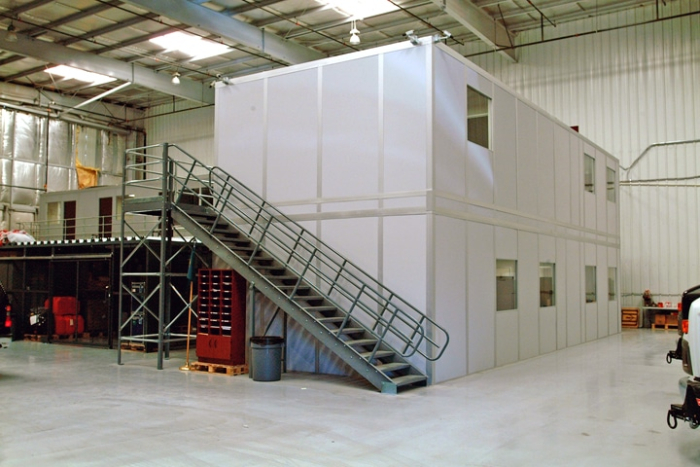
Modular construction gives you several ways to add space within your existing facility, without expanding the building itself. Here are some of the most common:
Two-Story Modular Offices
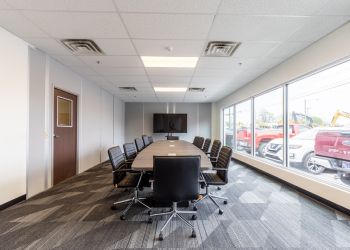
One of the most common ways to add office space efficiently within a warehouse or factory is through multi-story offices. By moving administrative work, meetings, and supervision off the production floor and into a vertical structure, you free up valuable ground-level space for operations. These can be complete with electrical, HVAC, lighting, and data.
Mezzanines
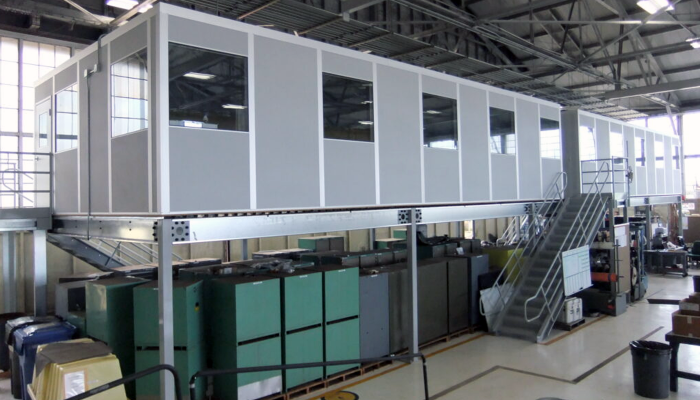
If you’ve got the ceiling height for it, a mezzanine lets you build upward. It even allows you to preserve the ground floor space.
Essentially, what it does is add a second floor within the building, tapping into the unused area. Mezzanines can be used for a whole variety of purposes, including offices, storage, work platforms, observation areas, and more.
It’s one of the most effective ways to double your usable space without touching your building’s footprint.
Why Go Modular Instead of Traditional Construction?
If you’re going to build inside your facility, why not just hire a general contractor? Fair question, but here’s why modular makes more sense for most situations:
Speed
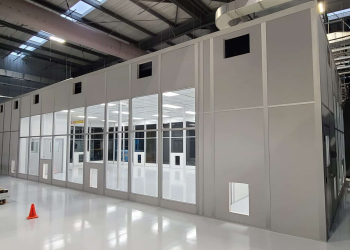
Modular offices and mezzanines can be installed in days or weeks. Traditional construction for the same project could take months. The parts, called “modules,” are manufactured off-site, so by the time they arrive, most of the work has already been done.
Cost
Modular is typically less expensive than a traditional structure. The factory-controlled process is much more efficient, which keeps overall costs down.
Fewer Disruptions
This is a big one. Modular installation doesn’t have to shut down or slow down your operations. For one, there’s not dust everywhere, and there’s also no loud noises for weeks on end. Your business keeps running while the space goes up.
Flexibility
Further, there’s the matter of flexibility, which is where modular really separates itself from traditional construction.
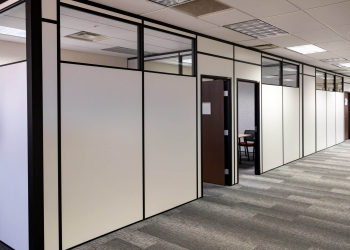
If your needs change, modular buildings can be disassembled, relocated, and reconfigured. This would be impossible to accomplish with drywall.
With traditional construction, changing your layout almost always means demolition.
Tax Advantages
Because modular structures are classified as tangible personal property (as opposed to “real property”), they depreciate over 5 to 7 years instead of 39. And under current tax law, they may qualify for Section 179 and bonus depreciation, which can let you deduct the full cost in year one. (We wrote a full breakdown of the tax benefits of modular construction here if you want a full explanation.)
Sustainability
Finally, modular construction is sustainable. It generates less waste, uses recycled materials, and the parts are reusable.
If your company cares about sustainability or is pursuing LEED certification, modular can contribute up to 25 LEED points.
The Bottom Line
If you need more space in your facility, it’s not necessary that you sign a new lease or begin a long construction project. In many cases, the space you need is already inside your building, you just have to use it differently.
If you’re running out of room and want to explore your options, contact Allied Modular today to get a quote.